Klovićevi dvori Gallery, Jezuitski trg 4
 Tuesday - Sunday, 11:00 - 19:00
7. September 2026.
Tuesday - Sunday, 11:00 - 19:00
7. September 2026.

Dear creatives,
On Saturday, September 12, from 11:00 AM to 12:30 PM, we are starting a new series of creative workshops.
Registration is required via e-mail at: artionica@gkd.hr
Please include the child’s full name and age in your registration. We can also arrange all workshops to suit kindergarten-aged children as well as primary and secondary school students; these sessions can be scheduled on weekdays by prior arrangement.
We are looking forward to welcoming you to the new Artionica workshops and the exhibition space of the Klovićevi dvori Gallery.
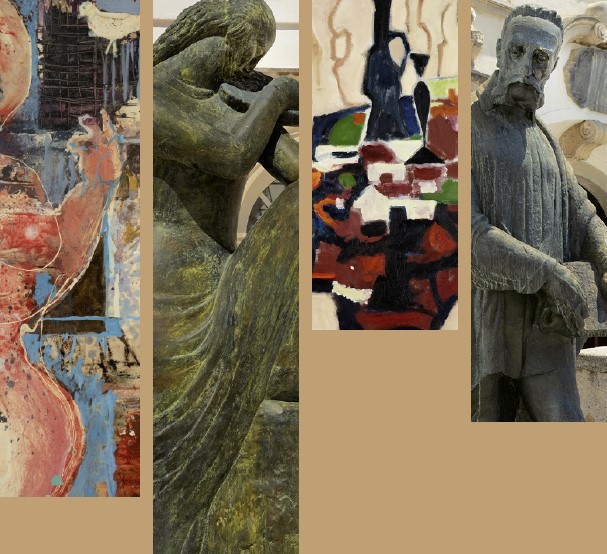
The Klovićevi dvori Gallery has organized the exhibition “A Foundation for the Future – The Klovićevi dvori Gallery Collection of Donated Artwork” as part of the Zagreb Museum Weekend. Following solo exhibitions at Klovićevi dvori Gallery, certain artists have decided to donate at least one artwork, resulting in a collection of over a hundred pieces – you can view some of these artworks at the aforementioned exhibition, and use the original artworks as inspiration to create your own art in our Artionica workshop space.
1. PAINTING WORKSHOP
September 12, 2026: 11:00 AM – 12:30 PM
JOSIP TROSTMANN, Summer in Dubrovnik
Josip Pino Trostmann – described by art critic Tonko Maroević as the “visual poet of Dubrovnik” – has been capturing the atmosphere of the city and the natural beauty of its surroundings on canvas since his early youth. Light plays a pivotal role in Trostmann’s work – he manipulates it masterfully, observing: “A sunny day is my primary impulse to paint. The sun bestows a vibrant palette upon the Mediterranean. A sense of joy naturally emerges”. Many consider that he skilfully dances on the boundary between Impressionism and Expressionism, all while adding a touch of abstraction”.

TASK: The inspiration for your artwork will be this image of summer – a picture defined by cheerful, warm colors as the primary compositional element; colors that hold value in their own right, independent of any specific object or subject. Your task is to paint the emotion evoked by the thought of summer days through color harmony. Let color come alive as an independent artistic element.
2. DRAWING WORKSHOP
September 19, 2026: 11:00 AM – 12:30 PM
JOSIP VANIŠTA, Portraits and Figures
Academician Tonko Maroević wrote the foreword to the print portfolio “Josip Vaništa: Twenty-Five Drawings”. He provides detailed analysis of Vaništa’s portraits of great writers and thinkers, such as Miroslav Krleža, Antun Branko Šimić, Franz Kafka, Fyodor Dostoevsky and Dobriša Cesarić. Maroević explains that these drawings are not merely depictions of faces, but profound psychological and intellectual “psychograms” in which Vaništa captures the essence of the subjects with minimal strokes. Faces emerge from the whiteness of paper through just a few subtle, precise lines, focusing on the subject’s inner state.

TASK: Although everyone recognizes Tin Ujević by his hat and coat, Vaništa drew his portrait without the hat, capturing his true face. His style taught us how to convey character and expression using just a few elements. Your task is to create a portrait without superfluous details, using as few lines as possible. When you finish, your paper should still be brilliantly white, just like Vaništa’s.
3. COLLAGE WORKSHOP
September 26, 2026: 11:00 AM – 12:30 PM
ANTON VRLIĆ, Trains
Anton Vrlić is a Croatian painter (Split, 1957), who paints in the spirit of abstract expressionism, employing a distinctive use of color and unusual, evocative forms. In his more recent work, he utilizes unconventional painting techniques (such as reliefs, punctures and patches on canvas).

TASK: Imagine that night has fallen and our magical green train is speeding through the forest and colorful autumn leaves. Let’s all imagine and create a collage of that magical green train and the autumn forest it travels through.
4. PRINTMAKING WORKSHOP
October 3, 2026: 11:00 AM – 12:30 PM
VIRGILIJE NEVJESTIĆ, Cantique des jours
Many critics have written about Vergilije, including art historian and former director of the Museum of Arts and Crafts in Zagreb, Miroslav Gašparović: “Virgil is a master of the small format, of the graphic miniature, which has claimed a unique place in his body of work. Although each one is a complete work of art in itself, by arranging them within a single larger print sheet, Nevjestić creates dynamic constellations – groupings of miniatures that establish distinctive yet carefully considered relationships, through which the artist imposes his own order upon the chaos of life.”

TASK: Your task is to create a print featuring several miniature depictions of your own childhood. Imagine a window divided into four panes, each holding its own story. We will create this entire piece using the drypoint printmaking technique.
5. PAINTING WORKSHOP
October 10, 2026: 11:00 AM – 12:30 PM
ŽELJKO HEGEDUŠIĆ, The Painter’s Freedom
The painting “The Painter’s Freedom” (dating from the 1970s) was donated to the Gallery in 1999, coinciding with the retrospective exhibition “Željko Hegedušić: Paintings, Drawings and Prints, 1926-1999”. The fact that the painting dates from the 1970s is crucial for a precise analysis of its artistic context. It was at the begining of that decade that Željko Hegedušić experienced a major creative turning point. After dedicating himself primarily to drawing and printmaking for decades, he returned fully to painting and color in the 1970s, creating his most imaginative and unconstrained works. Until then, he was known for social themes, urban vistas and rigorous surrealist drawings influenced by Parisian Purism. However, during this decade, his artistic style underwent a radical liberation. The background became an open expanse filled with flat, associative shapes, tending toward abstraction, yet, the introduction of a recognizable form (such as a bird) revealed the artist’s desire not to completely abandon the tangible world. Hegedušić’s work from this period is often described as a blend of refined dark humor, the grotesque and elements of the world of childhood and imagination.

TASK: Let the title of our artwork be “The Joy of Creation” – Let us express our emotions using colors based on the warm and cool contrast of shapes.